- +1-888-508-2837
- 1 Old Country Rd, Carle Place, NY 11514
- info@meccapayments.net


Every business owner I talk to, from small retail shops to high‑volume service providers, asks the same thing:
“Why does my processing cost more than it looks like it should?”
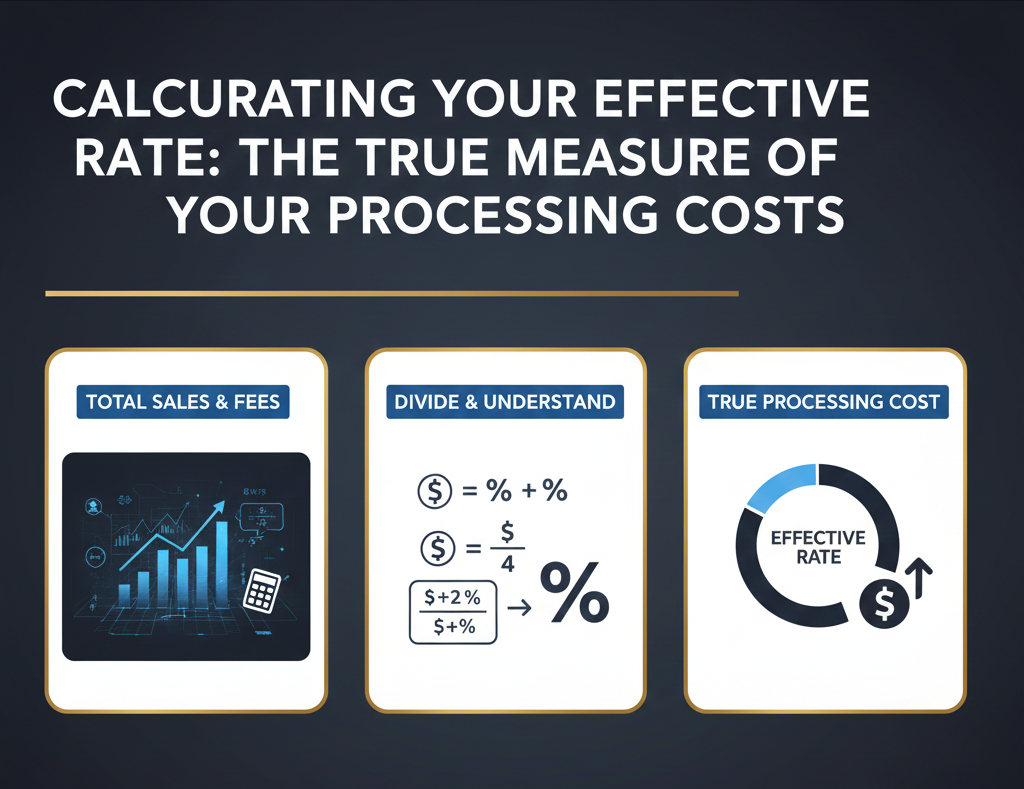
You’re not imagining it, the numbers your payment processor advertises rarely reflect the true cost you’re paying to accept credit and debit cards. That’s why the concept of the effective rate is so important. It gives you a single, honest metric to compare processors, understand your costs, and identify opportunities to save.
In payment processing, your effective rate is the total processing costs you pay divided by your total credit card sales volume, not the advertised headline rate. This reflects every fee you actually pay, not just a select few.
Formula:
For example, if you processed $50,000 in card sales last month and paid $1,250 in total processing fees, your effective rate would be:
This means you’re paying 2.5% of your total sales in processing costs, your true cost of accepting cards.
Unlike the advertised “2.9% + $0.30” or other quoted rates, your effective rate gives you the full picture, including:
Interchange fees set by Visa/Mastercard
Processor markup and gateway fees
Monthly account fees
PCI compliance fees
Chargebacks and assessment fees
That’s why many businesses find they’re paying much more than expected, sometimes 3%, 4%, or even higher.
Processors often advertise only their lowest possible rate, usually the “qualified rate,” which applies only to ideal transactions. But your actual costs include dozens of other charges that never make it into the headline.
Here’s what typically gets missed:
Tiered pricing downgrades
Non‑qualified transaction fees
Gateway and statement fees
PCI and compliance fees
Chargeback and batch fees
That’s why two processors can both advertise “2.7%” but end up with very different effective rates on your statement.
A café with $75,000/month in sales thought it was paying 2.7%. After adding gateway fees, chargeback fees, and non‑qualified pricing, the total monthly fees were $3,000, yielding an effective rate of:
That 4% rate was 40% higher than the advertised rate.
Another merchant processing $120,000/month believed they were under control at a “low flat rate.” When we added all the fees together, their effective rate was 3.6% higher than many industry averages, revealing room for transparency and savings.
These real examples show why the effective rate is the only metric that truly compares your costs across providers or pricing models.
Many merchants fall into two traps:
Comparing quoted rates (like “2.9% + $0.30”)
Looking only at interchange rates
Both of these ignore the hidden fees that drive up your actual cost. The effective rate resolves that by capturing everything you actually pay.
This is especially important when processors bundle fees, delay charges, or carry costs over multiple billing cycles, all of which can distort your real costs.
Gather your statements: Collect at least one to three months of processed statements.
Total all fee: Include interchange, processor markup, gateway, PCI, monthly minimums, and chargeback fees.
Find your total sales volume: Add up your credit/debit card sales.
Apply the formula: Divide total fees by total sales and multiply by 100.
This simple process gives you a powerful number that reflects your actual cost.
Simple: one number that reflects your overall cost
Accurate: includes every fee you pay
Comparabl: lets you compare providers fairly
Actionable: shows you where savings opportunities exist
Instead of negotiating solely on “2.75% vs 2.9%,” smart merchants focus on reducing their effective rate, which often reveals much larger savings.
If you’re serious about understanding your processing costs, the effective rate isn’t just a number it’s your guide to true savings. It tells you what things really cost, not what processors want you to think they cost.
At Circle Processing, our Merchant Analytics and Transparent Reporting tools help businesses precisely calculate this metric and uncover savings opportunities they never knew existed. Once you know your effective rate, negotiating, comparing, and optimizing become straightforward, no smoke and mirrors.
Q1: What is the effective rate?
Your effective rate is the total processing fees you paid divided by your total card sales, giving you a percentage of what you actually pay.
Q2: Why is the effective rate more useful than advertised rates?
Adverts show the lowest possible rate, but your effective rate captures every fee you pay, including hidden or situational charges.
Q3: How often should I calculate my effective rate?
At least quarterly, ideally monthly, trends over time show when costs spike or hidden fees appear.
Q4: What fees are included in the effective rate?
Processor markup, interchange, gateway fees, monthly account fees, PCI fees, chargebacks, and incidental charges.
Q5: Should I compare effective rates across processors?
Yes, only the effective rate makes apples‑to‑apples comparisons possible, regardless of pricing model.
Q6: What is a good, effective rate for credit card processing?
A typical target range for many merchants is around 2.5% to 3.5%, though this depends on your industry and mix of card types. Rates above 3.5% may signal opportunities to negotiate or adjust pricing models.
Q7: How are pharmacy claims billed?
In processing, every transaction has multiple underlying fees, similar to how claims are submitted and adjudicated in pharmacy billing.
Q8: How do insurance claims work?
Just as a pharmacy verifies and adjudicates claims step by step, merchant processing reports must be examined step by step to reveal true costs.


This will close in 20 seconds